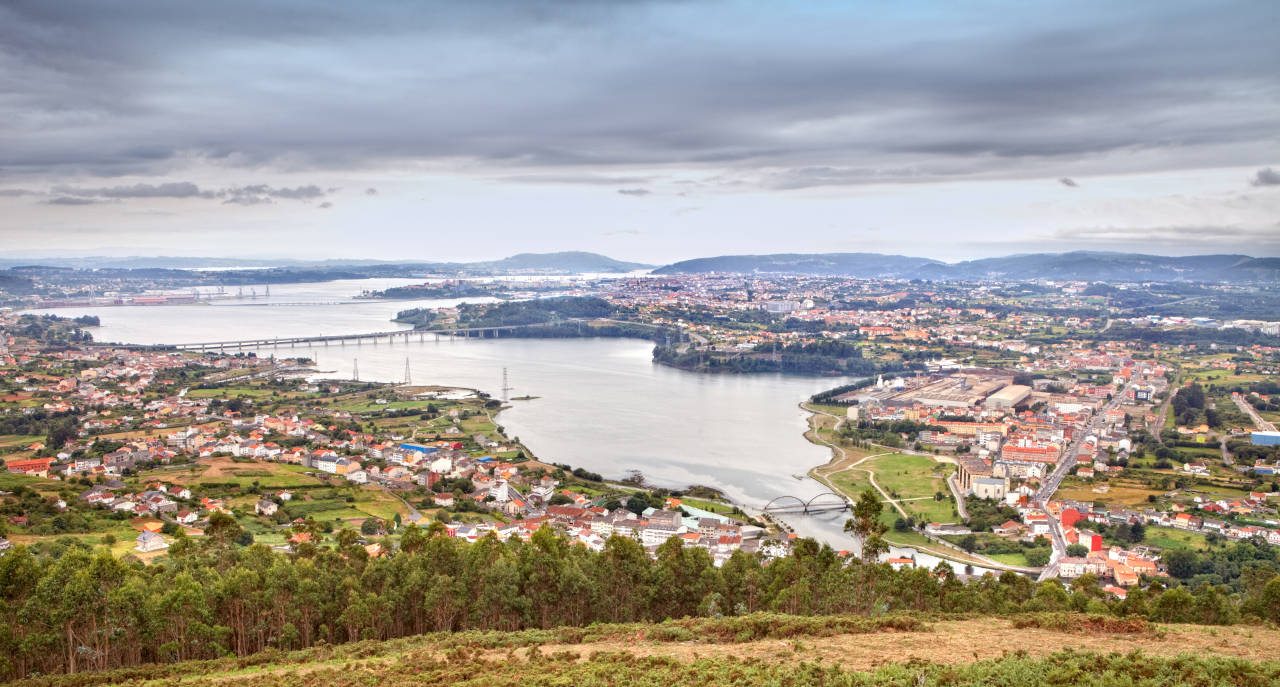
Camino Inglés
113 kilometres from Ferrol to Santiago de Compostela
The Camino Inglés (the English Way) developed from the medieval pilgrimages of people who travelled to Galicia by sea from England, Ireland, Scotland, Scandinavia and other parts of northern Europe. Ships landed at Ferrol and A Coruña, allowing pilgrims to complete the final part of their journey to Santiago de Compostela entirely within Galicia.
The two branches meet at Bruma before continuing together towards Santiago. Unlike the much longer routes from France and Portugal, the Camino Inglés preserves the final overland stage of what was originally a pilgrimage made largely by sea.
Places of interest along the Camino Inglés

Ferrol
Ferrol was a small fishing port until the Spanish monarchy transformed it into a major naval base and shipbuilding centre during the 18th century. The new arsenal and royal shipyards brought rapid population growth, and naval engineers laid out A Magdalena as a geometric Enlightenment-era district beside them.
From the Middle Ages, Ferrol was also one of the Galician ports used by pilgrims arriving by sea from the British Isles and northern Europe on their way to Santiago. That tradition survives in the Camino Inglés, whose modern route begins at the Porto de Curuxeiras.

Pontedeume
Pontedeume was founded by Afonso X in 1270 beside a wooden bridge over the Rio Eume, from which the town takes its name. In 1371 it passed to the Andrade family, whose buildings and symbols still appear throughout the medieval centre.
Fernán Pérez de Andrade replaced the wooden crossing with a monumental stone bridge that incorporated a chapel and hospital for pilgrims. Pontedeume's port also received pilgrims arriving by ship from England before they continued towards Santiago.

Betanzos
Betanzos was transferred to its present hilltop site by Afonso IX in 1219. It developed as a walled town and residence of powerful noble families, earning the name Betanzos dos Cabaleiros ("Betanzos of the Knights"). Until 1833, it was the capital of one of the seven provinces of the Kingdom of Galicia, alongside Tui and Santiago de Compostela. The Camino still enters the old town through the Porta da Ponte Vella, one of three surviving medieval gates.
Betanzos is also known for its tortilla de Betanzos, made without onion and characteristically served soft and runny inside.

Santiago de Compostela
Santiago de Compostela developed around a tomb identified in the early 9th century by Bishop Teodomiro as that of the Apostle James, although the attribution rests on religious tradition rather than historical proof. King Alfonso II of Asturias travelled to the site and ordered a church to be built over the tomb, helping establish the pilgrimage that would shape the city for centuries. Construction of the present Romanesque cathedral began in 1075. A medieval city grew around it to serve pilgrims arriving from across Europe.