Camino Portugués
242 kilometres from Porto to Santiago de Compostela
The Camino Portugués (Caminho Português, the Portuguese Way – also called Camino Portugués Central/Caminho Português Central, the Central Portuguese Way) follows the traditional inland route from Portugal to Santiago de Compostela. From Porto, it follows an old north-south corridor through northern Portugal, including sections associated with the Roman Via XIX, before crossing the Minho/Miño between Valença and Tui.
Historic river crossings at Barcelos, Ponte de Lima and Valença-Tui remain important landmarks along the route. Between Porto and Valença you will also see blue arrows pointing south towards Fátima, marking sections shared with the Caminho de Fátima.
Places of interest along the Camino Portugués

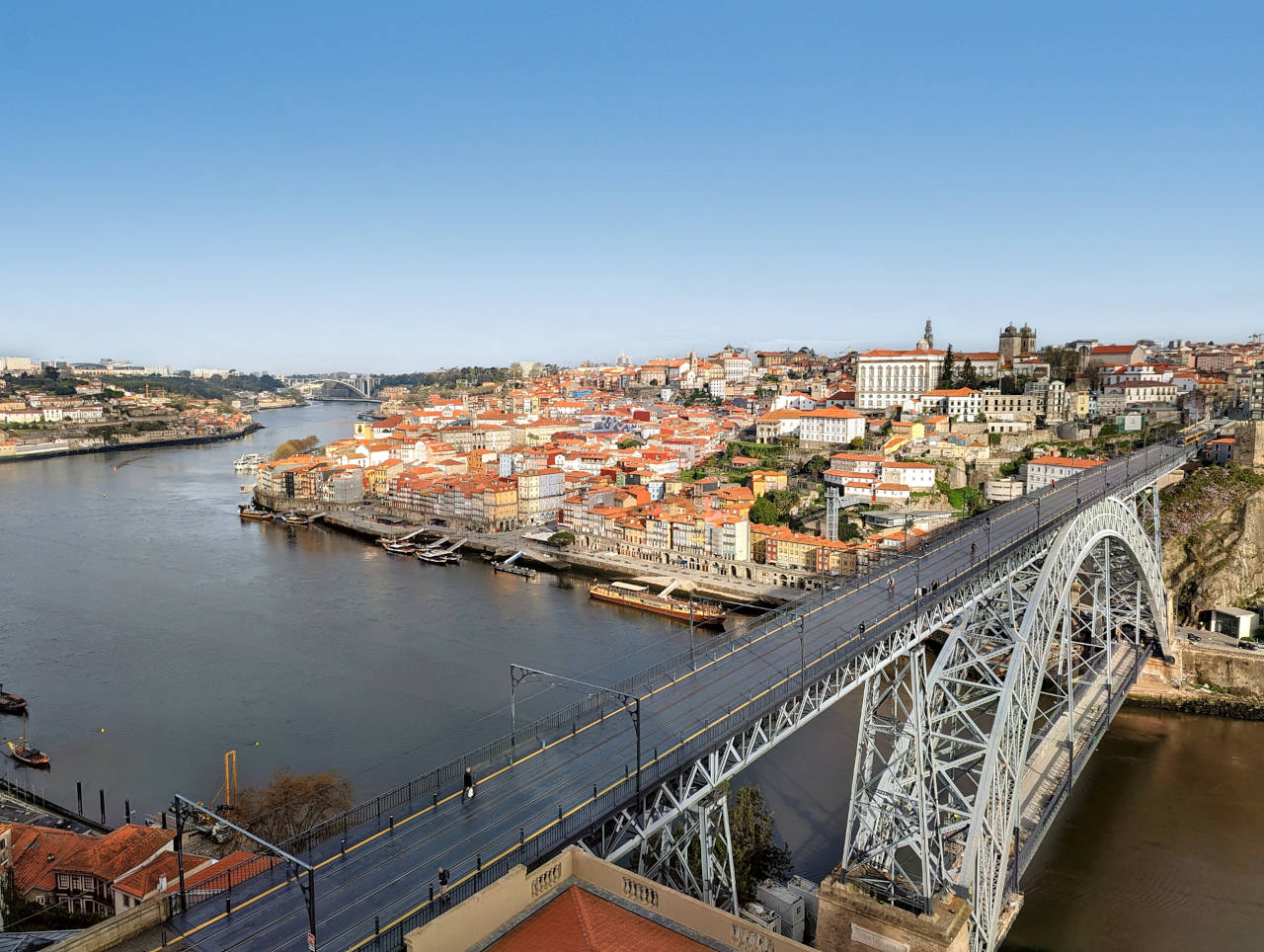
Porto
Porto developed around the hill above the Douro where the medieval city and its cathedral took shape. The name Portucale, used for Porto and the surrounding territory in the early Middle Ages, eventually gave its name to Portugal.
Its position at the lowest practical crossing of the Douro made Porto a gateway between northern and southern Portugal. For pilgrims arriving from the south, the route climbed from the river through the medieval city before continuing north towards Santiago de Compostela.
Today Porto is one of the main starting points for both the Caminho Português Central and the Caminho Português da Costa.

Valença
Valença began as the fortified medieval settlement of Contrasta, meaning "the one opposite", facing Tui across the Rio Minho. After repeated conflict along the Portuguese-Galician frontier, Afonso III enlarged its defences and renamed the town Valença in 1262.
The old town still sits inside the fortress, separated from the modern town that spread outside the walls. For pilgrims, Valença is also the last town in Portugal before the Camino crosses the Minho into Galicia.

Tui
Tui rises above the Río Miño opposite Valença, with medieval streets climbing from the river towards its fortified cathedral. An episcopal seat from the 6th century, it later became one of the seven provincial capitals of the Kingdom of Galicia, alongside Betanzos and Santiago de Compostela.
Tui is where the Caminho Português enters Galicia from Portugal and is a common starting point for pilgrims, since it lies more than the minimum 100 km walking distance from Santiago required for a Compostela.

Pontevedra
Pontevedra is the capital of Pontevedra province, although Vigo is larger. Its name comes from Ponte Veteri ("old bridge"), the Roman crossing of the Rio Lérez that preceded today's Ponte do Burgo.
During the 15th and 16th centuries, Pontevedra was the leading port of the Rías Baixas, supported by fishing, fish-salting and maritime trade. Much of this wealth was concentrated in A Moureira, the seafaring quarter whose Gremio de Mareantes (Seafarers' Guild) helped finance the Basílica de Santa María a Maior.

Santiago de Compostela
Santiago de Compostela developed around a tomb identified in the early 9th century by Bishop Teodomiro as that of the Apostle James, although the attribution rests on religious tradition rather than historical proof. King Alfonso II of Asturias travelled to the site and ordered a church to be built over the tomb, helping establish the pilgrimage that would shape the city for centuries. Construction of the present Romanesque cathedral began in 1075. A medieval city grew around it to serve pilgrims arriving from across Europe.