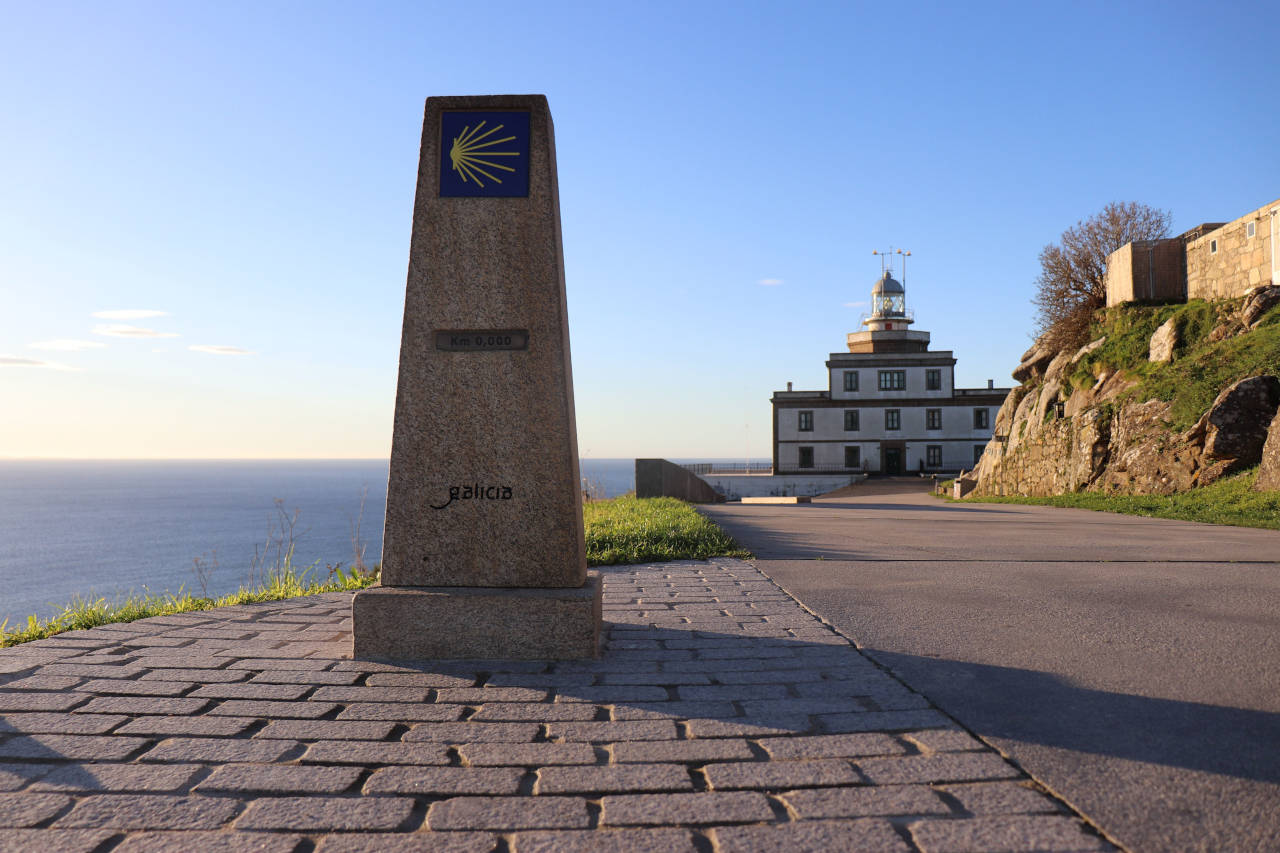
Camino de Fisterra
86 kilometres from Santiago de Compostela to Fisterra
The Camino de Fisterra (the Fisterra Way) is unusual among the Camino routes because it begins in Santiago de Compostela, where the others end. Since the Middle Ages, pilgrims have continued west towards the Atlantic, drawn to the Santo Cristo de Fisterra, a 14th-century Gothic crucifix venerated in the Igrexa de Santa María das Areas, and the sanctuary of the Virxe da Barca in Muxía. The name Fisterra comes from the medieval Latin fines terrae ('the confines of the earth'), referring to the headland once regarded as the western edge of the known world.
The route leaves Santiago through the valley of the Río Sarela, crosses the medieval bridge at A Ponte Maceira and continues through Negreira and the rural villages of western Galicia. Near Hospital, it divides into two branches: one descends to the coast at Cee and follows the Ría de Corcubión towards Fisterra and its lighthouse, while the other leads to Muxía.
Places of interest along the Camino de Fisterra

Santiago de Compostela
Santiago de Compostela developed around a tomb identified in the early 9th century by Bishop Teodomiro as that of the Apostle James, although the attribution rests on religious tradition rather than historical proof. King Alfonso II of Asturias travelled to the site and ordered a church to be built over the tomb, helping establish the pilgrimage that would shape the city for centuries. Construction of the present Romanesque cathedral began in 1075. A medieval city grew around it to serve pilgrims arriving from across Europe.

Fisterra
Fisterra takes its name from the Latin finis terrae ('end of the earth') and is the destination of the Camino de Fisterra, which ends at the Atlantic headland beyond the town. Its old centre rises above a working fishing harbour, where boats still land their catches for auction at the lonxa (fish market).